Time to read 4 mins
What is Blocking?
Blocking is the penultimate step in garment knitting. (The last step is usually weaving in ends.)
Blocking is the act of submerging a knitted garment in water or steaming it, to get the required form of the garment and to “relax” the stitches in order to get the best fit possible.
This helps the garment mesh together to construct cohesive fabric. It is like a spa treatment for your hand knits.
Do I really need to block my knitting?
Blocking does little to some fibres. For example, synthetics like acrylic or some animal fibres like mohair and alpaca, I just give the garment a gentle wash and lay it flat to dry but I don’t think blocking does much to accentuate the look of such fabrics so blocking can be skipped.
However, if you knit with plant based fibres, (linen, cotton, bamboo) or pure wool, the process of blocking can completely change the final look, feel and drape of your final garment, making stitches appear softer and more even, so it is a necessary last step.
You can’t really rush blocking either: it is important to let the item completely dry to really see that “finished” transformation.
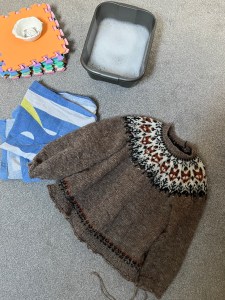
Here I will take you through how I blocked my Into the Wild sweater, pattern by Tania Barley.
Yarn: Plötulopi (oatmeal, white and black) and Holst supersoft (ember) for the foxes on the colourwork
The cast-off hem is a little wonky to me so this is something I hope I can rectify with blocking.
Materials
- You will need a basin or your sink and some lukewarm water
- A towel
- Blocking mats (Tip: I use play mats for babies because they are a fraction of the cost of blocking mats and are exactly the same)
- Blocking pins – I use T pins because they are easier to push in and pull up.
- Soap (I am using “Knit IQ” which is a wool soap but this is not a necessity, any mild liquid detergent will do)

Wet Blocking
I almost exclusively wet block because I feel like all the garments I spent month knitting could always do with a wash. Some people prefer steam blocking with an iron or a steamer, which I cannot comment on as I’ve never steam blocked.
Steps:
- Submerge the garment in water.
- I usually gently agitate the garment to help get any dirt out
- Soak 5-10 mins
- Remove the garment from water and press, not wring, the excess water out.
- Roll inside of a clean towel, I walk up and down on the rolled towel to really squeeze the excess out.

- Next, lay out your blocking mats or a towel and garment on top.

- Take the time to reshape and smooth out the fabric so all your stitches dry flat and even. If you want your garment to fit specific measurements, this is the time to measure the garment and stretch/shape to required size.

- Pin in place and leave to dry.

- Depending on the material, size and thickness of your garment, drying could take between 24-48 hours. Placing it near a heat source can help it to air dry faster.

- As it dries, periodically smooth your garment down to ensure it dries as you want it.
- Let your garment fully dry before taking it off the blocking mats.
Testing for colourfastness
It’s nice to knit with dark or bright colours, especially in colour work but if you contrast a light colour with a dark one, as I have here with the red foxes against the white background, it pays to exercise caution when washing for the first few times to prevent any colour runs and staining of the darker colour on the light.
I learnt that when using dark coloured yarn by Holst Supersoft, knitters found that colours bled quite a lot so before using the yearn, they rinsed or soaked the skeins to remove any excess dye before use. Unfortunately, I learned this after I had completed the colour work.
I had already used some Holst Supersoft in the colour Ember to knit the cuff and heel of a sock (yes, singular as I am yet to knit the second). The body of the sock is knitted in cream yarn so I used this as a tester for colourfastness. I soaked and blocked the sock and while it did turn the water very red, it did not stain the cream so I was good to go with this garment.
If you find yourself in a similar situation, you could wash your swatch if you were good and knitted a full colour work sample (- I didn’t. I only knitted a hasty a main colour swatch, for gauge, not colour work, oops), or you can just knit up a quick swatch using the colour of choice and a light colour and test wash and block.
If the colours had run and stain, I would have had to gently steam the garment, or skip blocking altogether.

Related: What’s on my needles
 All Homesteading
Leave a comment