Time to read 9 minutes
Gardening brings so much value and joy so it would be a mistake to believe you need a large garden and full sun to be able to do so effectively. I currently live in USDA Zone 9a and while I don’t have a lot of vegetable growing space, my garden is productive and I achieve seasonal yields of food to feed my family and of course, my tortoise.
In the past, I’ve lived in houses with large, mature gardens but I think I have found my wheelhouse for growing herbs, flowers and veg: in containers and small raised beds and here’s why:
You don’t need a lot of space to garden in containers
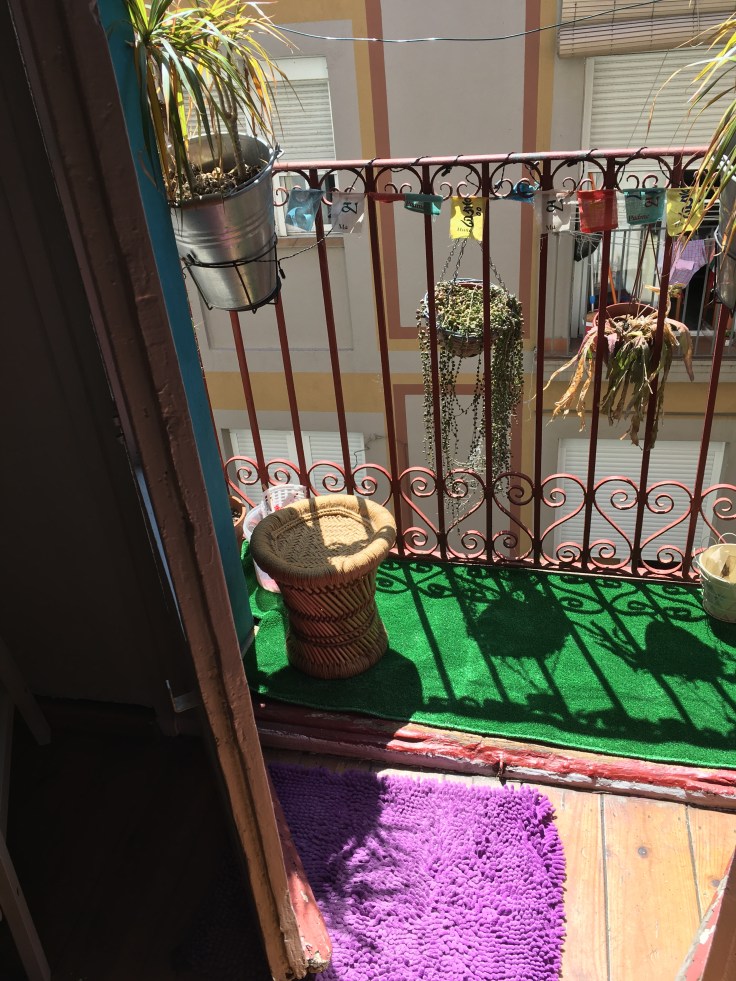
When I lived in centre of a Spanish city, I had a slither of sky up ahead and the tiniest of tiny balconies on the 3rd floor of an old, creaky building in El Raval, Barcelona. I decided to make an effort to get a few plants out there which gave it a bit of love and life. I certainly was not growing food or anything of use on that balcony but it gave me joy just to grow and care for a plant a couple of plants. If I lived here again, I would definitely use this space to grow herbs, even a pot or two of my favourite veg!
The Benefits of Balcony Gardening
There are numerous benefits to growing food on a balcony. One is that you can grow a variety of fresh produce in pots, in a small space so handy to maintain on a daily basis. Grown together with flowers means you can attract good pollinators like bees and beautiful pest control like ladybirds into your garden to help you achieve bountiful harvests.
You can also grow vertically to maximise the space available to you.

The Problem With Large Mature Gardens
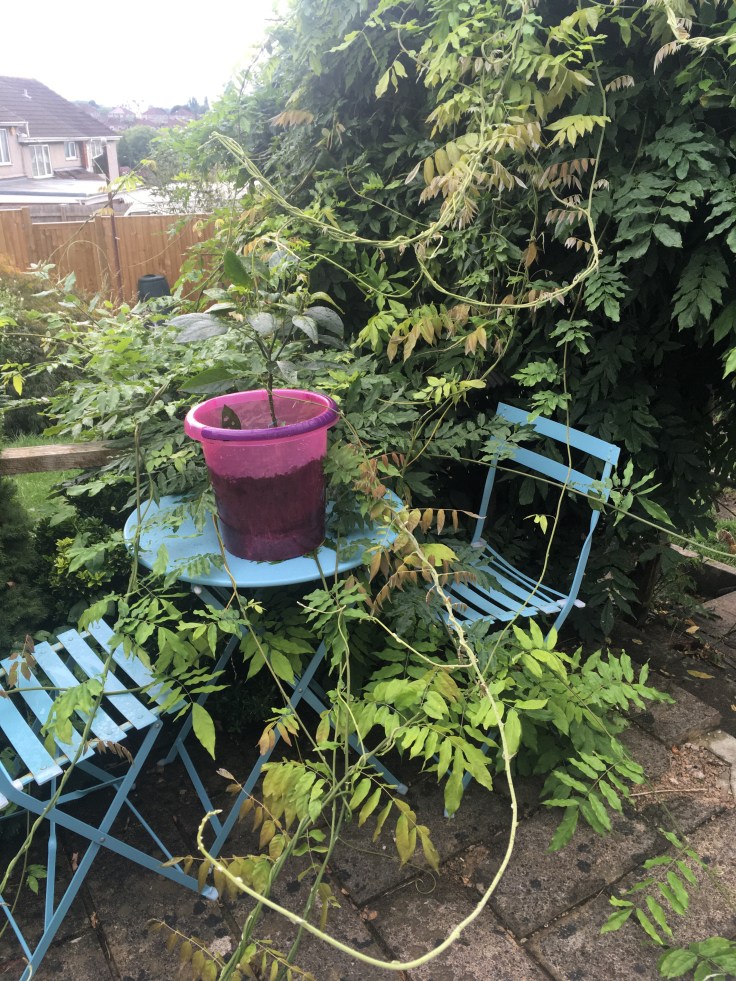
In 2018, I moved back to the UK…to a house! With a big, mature garden. There was a sumac tree, wisteria, firs…you get the idea. While I appreciated being in close proximity to beautiful specimens of trees, ones that had reached the stage of maturation that they only needed an annual, or biannual prune, toward them I felt a mixture of intimidation and indifference.
Could those shrubs have benefitted from more of my care and attention? – almost certainly, but I could not have taken any credit for their growth and beauty – I did not plant them and some years, we did not even get around to pruning them to keep them looking their best. In short, mature gardens are an asset but you need to keep on top of the pruning, which is a separate skill set to cultivating crops of use in the kitchen or around the home.
The work-around: Container Gardening
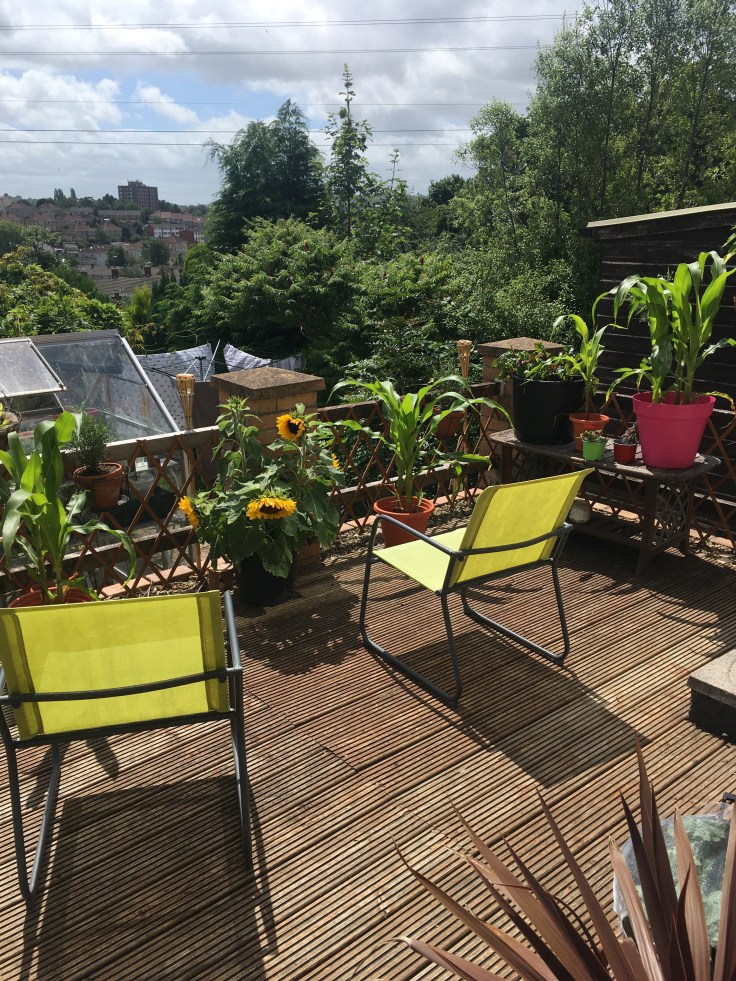
The well-established mature shrubs and trees and double lawn, occupied most of the garden real-estate here in our old garden, (above) so I decided to fill the decking, the old greenhouse, up the outside walls of the house and even on the outer walls of our shed, with containers (below).
Choosing What to Grow
I tend to grow from either seeds (earlier in the season) or from online retailer, linky – YouGarden, especially their veggie plugs or fruit trees.
Over the years I have purchased a many veggie plugs, 3 blueberries, a lemon, a lime, orange and an apple tree from yougarden and have never been disappointed. If you would like to purchase anything from yougarden, please use my link. I will earn a small percentage from your order, at no cost to you and will go a long way to helping me to continue to produce content that you hopefully find useful.
Growing medium
The best growing medium is anything peat-free and free-draining. That is, a 2:1 ratio of coco coir, peat-free multipurpose compost or top soil with well rotted farmyard manure (to the bottom of pot) or a slow release fertilizer mixed with perlite would make a good all purpose potting mix.
See here how I save money on soil and growing medium when filling my containers.
Container Gardening- Making the most of limited space
Container gardening can be done anywhere and offers a flexible option to traditional gardening in the ground in beds. Over the years, you can build up your pot collection but at any one time, have as many pots as you desire and are comfortable with so it is a great way to get into gardening.
Some large and heavy duty pots can be costly but there are a lot of cheaper alternatives…Wilko is a great place to source very affordable pots and other gardening sundries, Charity shops are always worth a look and local garden centres are fabulous for low cost traditional terracotta pots.
Fortunately for me, most of my pots are second hand, either passed down to me from my mother in law, or abandoned in our old house’s undercroft (not discovered by us for about 3 years ! ) by the elderly previous owners of our old house.
In truth though, any container can be used, as long as it has adequate drainage, is big enough for the crop you’re growing and has not previously contained anything hazardous for human consumption if you’re looking to use it to grow herbs, fruit trees or veg.
Vertical Gardening

My vertical herb garden The exact ones I purchased years ago seem to be now out of stock but I am linking to a similar product. This is a link to Amazon for a similar product I purchased myself. If you choose to purchase this item using my link, I receive a small commission.
Hanging baskets and planters mounted on walls are great ways to utilise space. I have even started seeds of root vegetables like beetroot in hanging baskets when succession planting and then transferred them into deeper containers once grown into seedlings. I grow fresh herbs on the outer wall of our kitchen so they are always within reach while cooking, just outside of the kitchen door.
What crops and plants to choose for containers

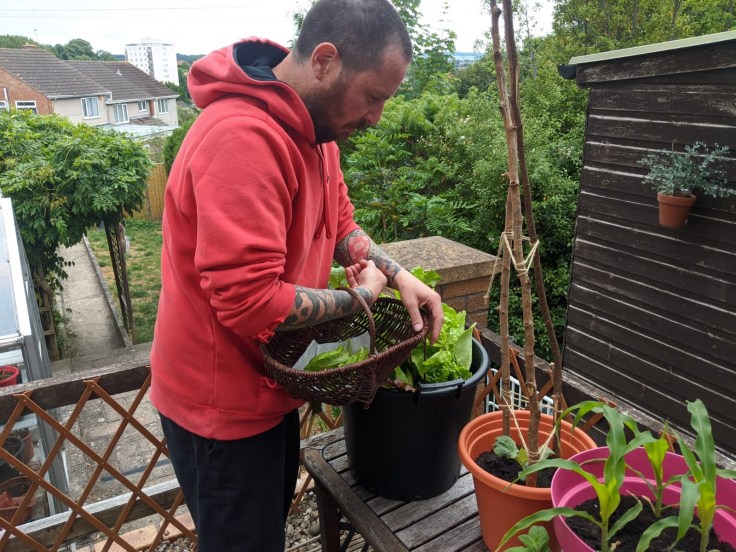
I tend to grow everything in containers, honestly. The trick is to match the shape and size to the container you have to the fully grown plant (check the seed pack or seedling packaging for that information.) For example, the lettuce grown in the pic above looks far too deep for the crop. A bit of a waste of space, really. That was a few years ago now and I have since learned that salad greens like lettuce, chicory and spinach can be successfully grown in much shallower containers. Yes it means that you don’t get a full head of lettuce, but harvesting early and regularly, means you get a “cut and come again” crop and can be successfully harvesting for over 3 months with just one batch of seeds sowed which to me, feels like I’m getting more for my money and effort. We like.
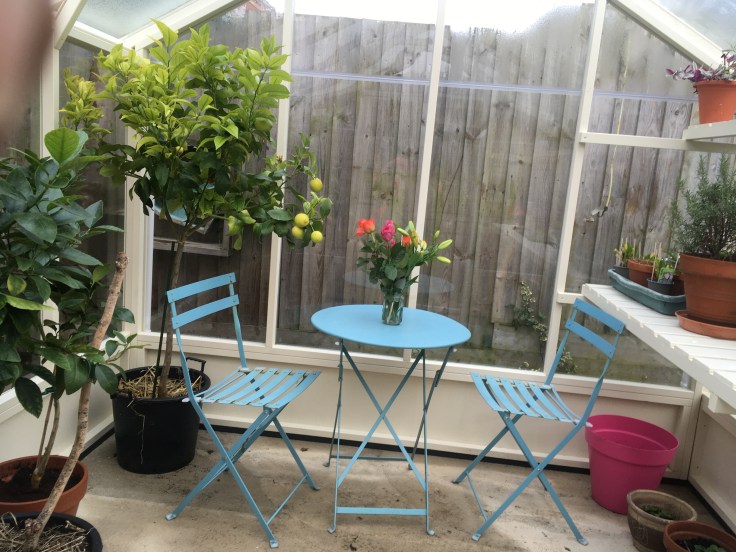
A better use for those heavy duty planters than for salad are for my lemon and lime trees. Those large planters are the biggest I own and hold 35l. Perfect for my heavy feeding and productive citrus plants. They’re great cos they have handles so ideal to carry in and out of the greenhouse in Summer, as the British weather permits to have them outside.
Watering and Mulching
The elephant in the room, is the primary downside to container gardening: the watering. Pots need to be regularly watered and fed, and the smaller the pot, the more watering it needs so when you have as many pots as I do, I would say container gardening is not low maintenance.
I tend to have to water every day while plants are producing fruit or actively growing, but it is also necessary to physically feel if the growing medium feels dry or crumbly down into the first 1 or 2 inches of your finger, water. This is just a general rule of…thumb (sorry). Some plants have their own particular requirements but a good way to tell is by what fruit the plants produce are like- if they are juicy, with supple skin think cucumbers, watermelons, strawberries etc, they’re heavy feeders and drinkers so need a lot of water. Root veg or potatoes or kale, not so much. I feed with a liquid seaweed feed every couple of weeks while plants are producing.
I also find that using a layer of straw or bark on surface of the compost in fruit and veg plant pots is a good way to reduce water evaporation and keep the compost hydrated for longer. This eventually will break down and feed the plant too so I always do this with all my fruit trees, potatoes, strawberries and in my raised bed.
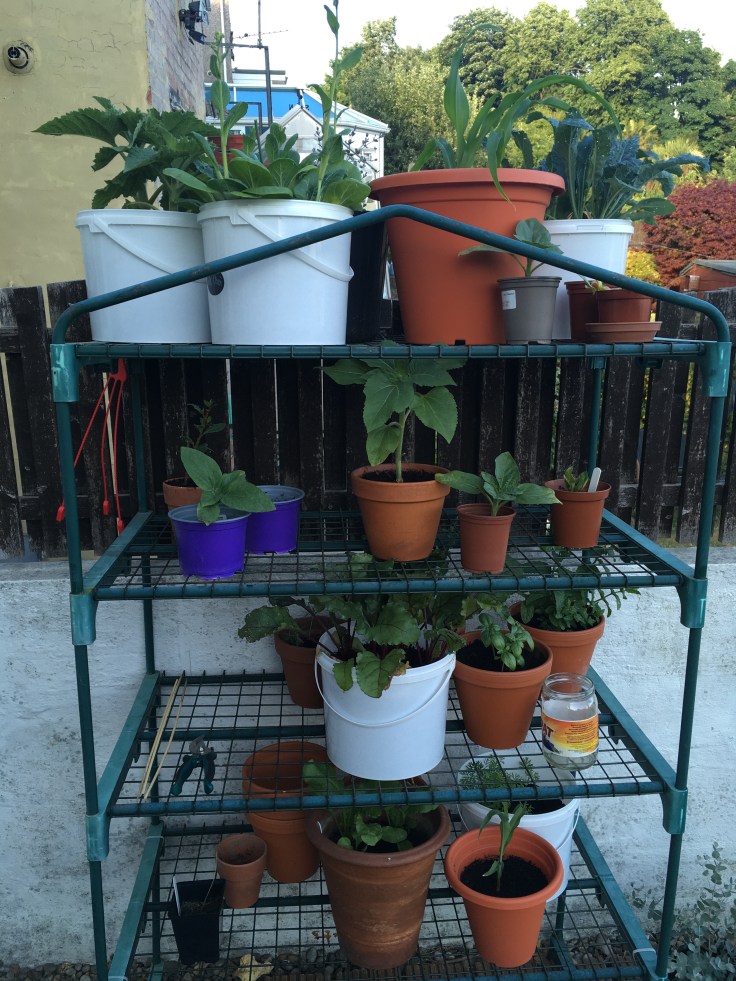
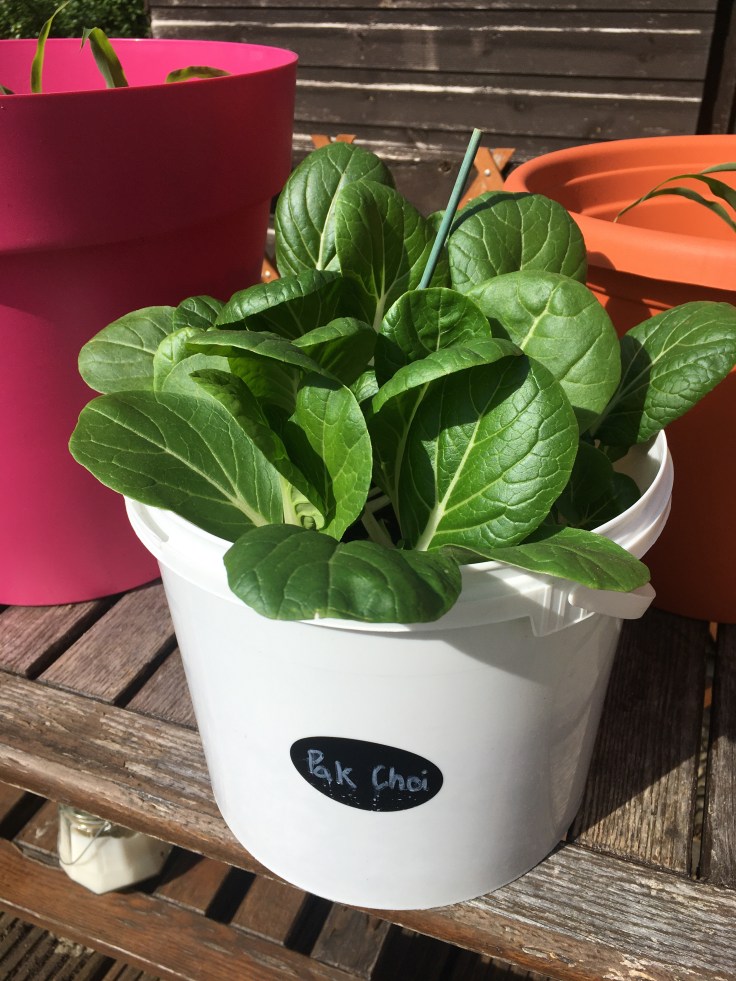
I bought a multipack of plastic containers and drilled drainage holes into them. They have little handles on them, like paint cans for portability.. I use them for growing salad leaves or in this case, perfect pak choi.

Hanging strawberries- hang any plant
I bought a set of plastic hanging hooks, off Ebay, that you can easily attach onto those plastic nursery pots which can turn any pot into a hanging basket. Last summer I realised that this was a great way to grow strawberries so I will definitely be repeating that this growing season.
Raised bed gardening
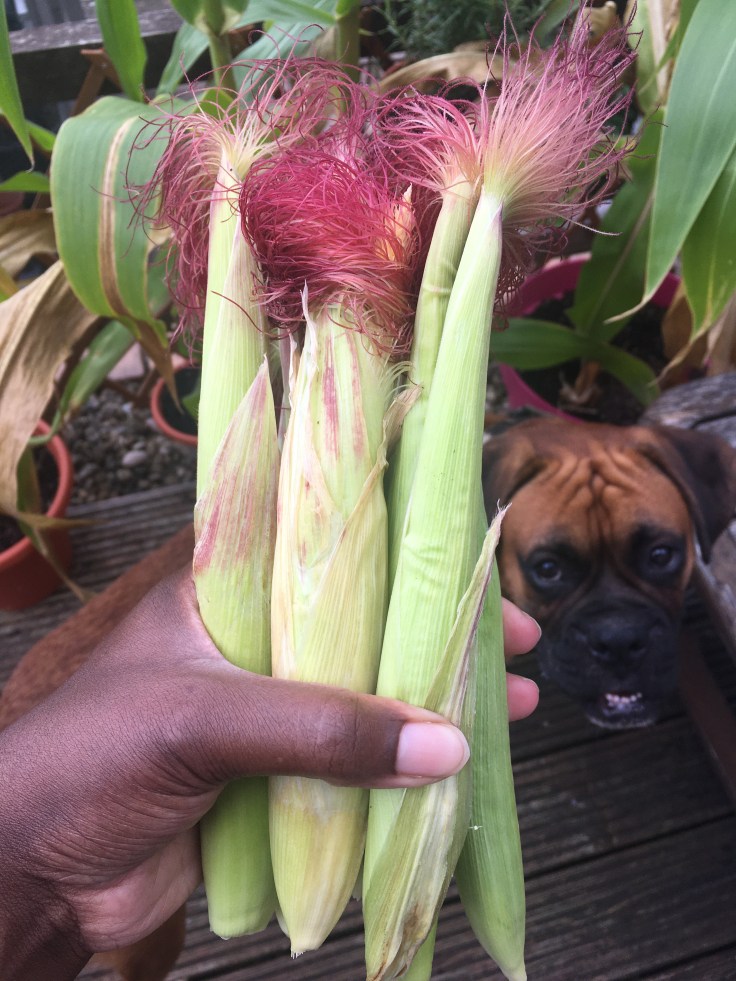
Last year, as well as gardening in pots, I decided to add a 6×4 raised bed in our front garden into the mix. Here, I adopted the “No Dig” square foot gardening approach which translated to 24 square foot individual veg patches where I successfully grew corn, kale, mange tout, broccoli, French beans, carrots, nasturtium and tomato. Again this will be repeated this year as it is a superb way to grow a lot of veg in a tiny amount of space. Because it was my first time growing veg in a raised bed, my approach was experimental to say the least. This year, learning from what worked and what did not, I will be adopting a more intentional method to get even more out of this space. I will also create blog posts detailing my refections and grow-season action plans in the near future.
So here is the evolution of container gardening over the past 10 years. While I may add different gardening methods to my repertoire, gardening in pots simply offers me the flexibility that I want. Container gardening is a great way to get into gardening if you don’t have much outside space and/or don’t know where to begin. Get a pot, choose your crop, fill with fresh peat free compost…bish bash bosh, never look back.
Happy Gardening!

 All Homesteading
Good article, I enjoyed reading this.
And what a cutie pup!
LikeLiked by 1 person
This is really a very informative guide. I especially loved the idea of using vertical space.
If you’re ever looking for more tips and ideas on growing vegetables, herbs, and even citrus in containers, feel free to check out my blog at GrowContainerly.com — where i share tips on container gardening for small spaces. Happy planting and thanks again for such an inspiring post!
LikeLike